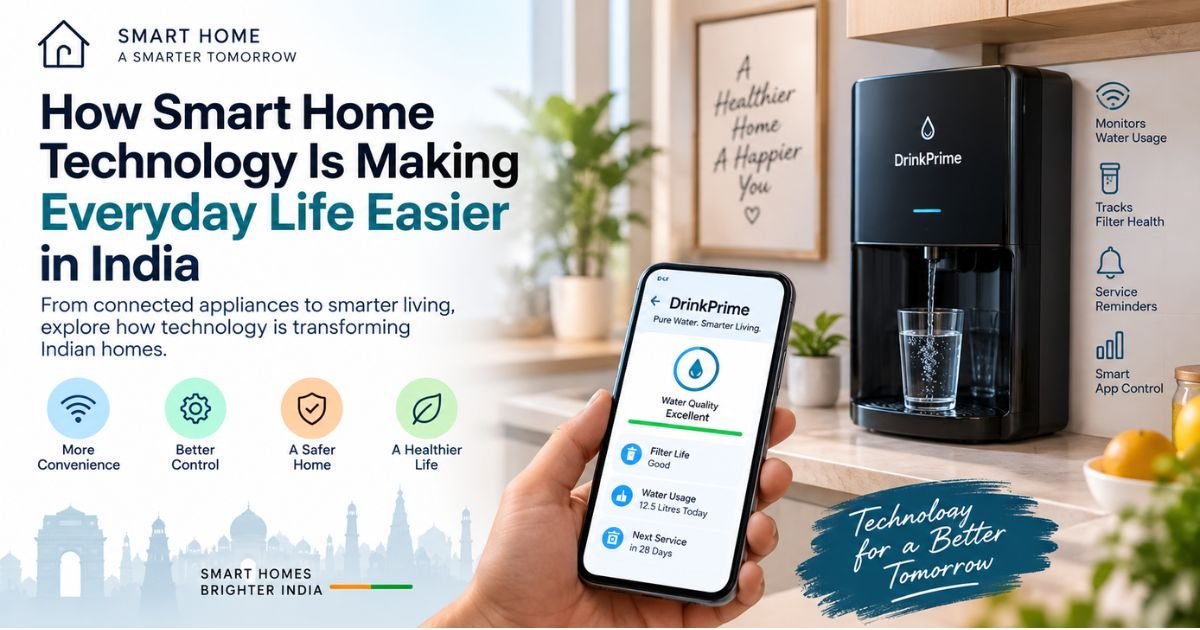
Discover how smart home and IoT technology is transforming Indian homes, from connected appliances and smart water purifiers to convenient subscription services.
Technology is becoming a bigger part of everyday life in Indian homes. From smart TVs and connected lights to security cameras and app-controlled appliances, devices that were once considered futuristic are now becoming increasingly accessible.
The growth of the Internet of Things (IoT) has played an important role in this change. Instead of operating as completely independent appliances, many modern devices can connect to the internet, collect information and provide users with greater control over everyday tasks.
One interesting example is the development of smart water purification systems. Water purifiers are traditionally viewed as simple kitchen appliances, but newer systems can combine purification technology with connected features, maintenance services and subscription-based models.
What Is Smart Home Technology?
Smart home technology refers to household devices that can connect to the internet or communicate with other devices to provide additional functionality.
Depending on the product, smart features can include:
- Monitoring usage through a mobile application
- Sending maintenance notifications
- Tracking consumption
- Providing information about device health
- Allowing users to control certain functions remotely
- Automatically collecting information for better service
The objective is not simply to make an appliance more complicated. The real advantage is convenience.
For example, instead of remembering when an appliance needs maintenance, a connected device may be able to provide relevant information through an app or notification.
The Growing Role of IoT in Indian Homes
India has seen rapid adoption of connected technology over the last few years. Smartphones and affordable internet access have made it easier for household appliances to become connected as well.
Smart speakers, televisions, cameras, lighting systems and home appliances are some of the areas where consumers can already encounter IoT technology.
The same concept is increasingly being applied to essential household services.
Water purification is a particularly interesting example because owning a purifier involves more than simply purchasing the machine. Filters eventually need replacement, the system may require servicing, and households need a reliable supply of purified drinking water.
A connected service can potentially make some of these responsibilities easier to manage.
Smart Water Purifiers Are More Than Just Appliances
A conventional water purifier primarily performs one job: purifying water.
A smart purifier can combine this basic function with connected services. Depending on the product and service provider, users may be able to access information about water consumption, filter condition or service requirements.
This can be useful for households where convenience is an important consideration.
For example, DrinkPrime offers connected water-purification services that combine water purifiers with a subscription-based service model. Its service includes app-based features such as monitoring water consumption and information related to the purifier.
For someone researching this type of service, checking a DrinkPrime Referral Code can also be one way to find out whether a referral benefit is available before starting a subscription.
Subscription Models Are Changing Appliance Ownership
Another major development is the growth of subscription-based services.
Traditionally, consumers purchased an appliance, paid the entire cost upfront and then handled maintenance themselves. Subscription models provide an alternative approach.
Instead of treating the purifier purely as a product, the consumer can receive the appliance together with an ongoing service.
This model can be attractive to people who prefer:
- Lower upfront costs
- Professional installation
- Ongoing maintenance
- Easier replacement of consumable components
- Flexibility compared with traditional ownership
However, subscription models are not automatically better for everyone. Consumers should compare the total long-term cost, contract conditions, cancellation rules and included services before making a decision.
Why Connected Appliances Can Be Convenient
One of the biggest advantages of smart appliances is visibility.
A traditional appliance can continue operating without giving the user much information about its condition. A connected appliance, on the other hand, can potentially provide additional information through software.
This can help with several everyday tasks.
1. Monitoring Usage
Usage information can help households understand how frequently an appliance is being used.
For a water purifier, consumption information can be particularly useful for understanding household drinking-water requirements.
2. Maintenance Awareness
Regular maintenance is important for many household appliances.
Connected systems can make it easier for users to receive information about servicing or component replacement instead of relying entirely on memory.
3. Greater Convenience
A major reason people adopt smart-home technology is convenience.
The ability to check information from a smartphone can save time and reduce the need to manually inspect an appliance.
4. Better Understanding of Household Consumption
As more household devices become connected, consumers can gain a clearer picture of how different appliances are being used.
This information can eventually help households make more informed decisions about their consumption and expenses.
What Should You Check Before Choosing a Smart Appliance?
Smart features can be useful, but they should not be the only factor when purchasing or subscribing to a household appliance.
Consumers should first look at the basic functionality of the product.
For a water purifier, this may include:
- The purification technology used
- Suitability for the household’s water source
- Capacity
- Maintenance requirements
- Filter replacement policy
- Installation arrangements
- Service availability in the user’s location
- Subscription or ownership cost
- Cancellation and renewal terms
After these factors are considered, smart features can be evaluated as an additional benefit.
Smart Does Not Always Mean Better
It is easy to assume that an appliance with more technology is automatically superior.
That is not necessarily the case.
A smart appliance should solve a genuine problem rather than simply adding features that consumers rarely use.
For example, a connected water purifier can be useful if its app and service system actually make maintenance and monitoring easier. But consumers should still consider the quality of purification, service network and overall cost.
The best smart-home products are generally those where technology improves an existing everyday experience without making it unnecessarily complicated.
The Future of Smart Homes in India
Smart-home adoption is likely to continue expanding as internet connectivity, smartphones and connected-device technology become increasingly common.
The next stage of this development may involve greater integration between different household devices.
Instead of having several independent smart products, consumers may eventually manage multiple aspects of their homes from centralized applications or connected platforms.
Water purification, energy management, security, lighting and other household services could become increasingly data-driven.
For consumers, the most important consideration will remain practical value. Technology is useful when it saves time, improves convenience or helps people manage their homes more effectively.
Final Thoughts
Smart-home technology is gradually moving beyond entertainment and convenience gadgets. Connected technology is now being applied to everyday household needs, including water purification.
Smart water-purification services demonstrate how an ordinary household appliance can be combined with IoT features, mobile applications and ongoing service.
For consumers considering such a service, the right approach is to look beyond the word “smart” and evaluate the purification technology, maintenance, pricing, service availability and subscription terms.
As connected appliances continue to become more common in India, the future of the smart home may not simply be about having more devices. It may be about making everyday household tasks easier, more transparent and more convenient.